Dzmitry Skazau/iStock via Getty Images
Fast Facts About the PIMCO Investment Grade Corporate Bond Index ETF
The PIMCO Investment Grade Corporate Bond Index ETF (CORP) was launched on September 20, 2010 and tracks the ICE BofA US Corporate Index. CORP has over 1300 holdings, a total expense ratio of 0.41%, a 30-day SEC yield of 5.43%, and a trailing 12-month yield of 5.06%. Distributions are paid on a monthly basis. It is quite a large, liquid ETF with over $1.3 billion in assets under management and $10 million in average daily trading volume. The fund’s issuer, PIMCO, is a global leader in fixed income funds with over $2.3 trillion in total assets under management. PIMCO is a majority-owned subsidiary of Germany-based financial services and insurance company Allianz SE (ALIZY).
CORP’s strategy
As described in the prospectus by PIMCO, the underlying index focuses on “U.S. dollar-denominated investment-grade corporate debt securities publicly issued in the U.S. domestic market with at least one year remaining term to final maturity”. For eligibility, both the security and the issuer’s country of risk must have an investment grade (“IG”) or equivalent quality. Eligible securities must have a fixed coupon and at least $250 million of outstanding face value. The index is capitalization-weighted, reconstituted monthly, and comprises over 10,000 securities. The fund invests at least 80% of its asset value in a representative sample of the index, and may also hold other fixed income instruments, cash and derivatives. The portfolio turnover rate was 18% in the most recent fiscal year.
Portfolio
The portfolio composition is based on data available on September 20, 2026. It may have changed by the time you read this. About 89% of asset value is in securities that identify the US as the main country of risk. The fund has 1,388 holdings, with about 95% of net asset value in corporate IG debt, 10% in US Treasuries, and is short 5% in short duration instruments. It also holds credit default swaps and currency forwards.
The fund has significant exposure (56.5%) in debt rated A- to BBB-, the lower tiers of the IG category, and a marginal weight (1.5%) in below-IG securities.
The effective maturity is 10.7 years, with 81.5% of assets maturing in a range of 3-10 years.
Maturity ladder, % of net asset value (PIMCO)
The effective duration of 6.3 years points to average interest rate risk. It means asset value would change by approximately 6.3% when rates change by 1%, in the opposite direction. However, it is not an exact measurement, and that prediction is not 100% reliable.
Company-specific risk is low: the heaviest corporate issuer, The Southern Company, weighs only 2.6%. The sector breakdown is not disclosed, but the fund is likely to have notable exposure in financials: six large banks appear in the top 10 issuers, listed below.
* Weights of the top 10 issuers, calculated by the author from the holding list.
Performance
CORP has marginally outperformed the benchmark iShares iBoxx $ Inv Grade Corporate Bond ETF (LQD) by 12 bps annualized from September 27, 2010 through September 20, 2026, with lower risk metrics (maximum drawdown and volatility in the table below).
Data: Portfolio123
The two funds have lost about 7% in price over the past 16 years, and the gap between them is insignificant:
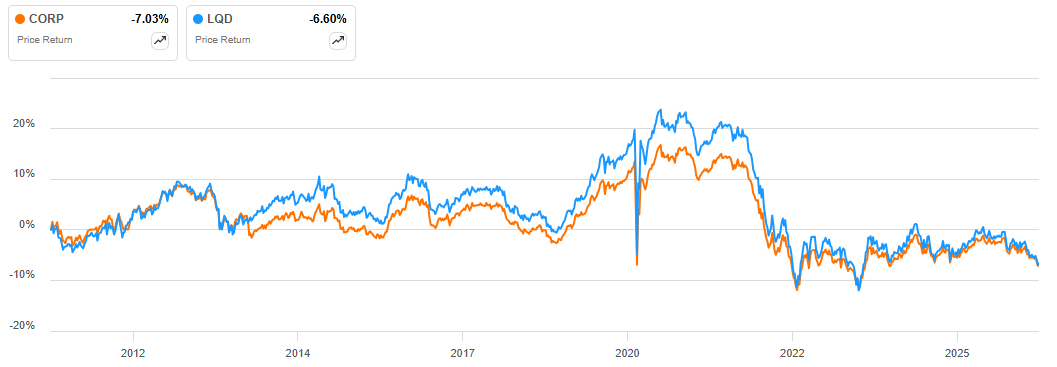
CORP vs benchmarks, price return since inception (Seeking Alpha)
The annual sum of distributions has increased by 50% between 2015 and 2025, following the trend of Treasury rates with a delay and muted amplitude, as shown on the next two charts.
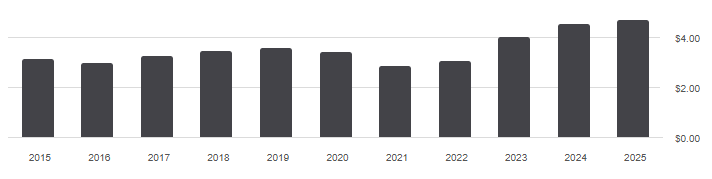
Distribution history (Seeking Alpha)
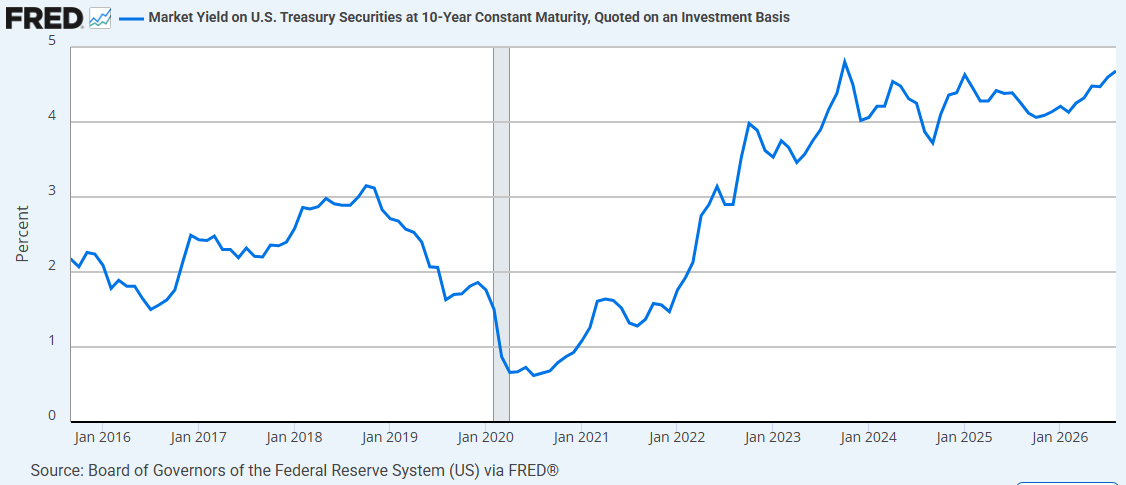
10-year Treasury yield (St Louis Fed, FRED database)
CORP vs. passive peers
The next table compares characteristics of CORP, LQD, and three large passive ETFs focused on IG corporate bonds without maturity restriction:
- iShares Broad USD Investment Grade Corporate Bond ETF (USIG)
- SPDR Portfolio Corporate Bond ETF (SPBO)
- Vanguard Total Corporate Bond ETF (VTC)
This list is not intended to be exhaustive.
Read More: CORP: Well-Rounded ETF In Corporate Bonds, But Not Low-Cost (NYSEARCA:CORP)